
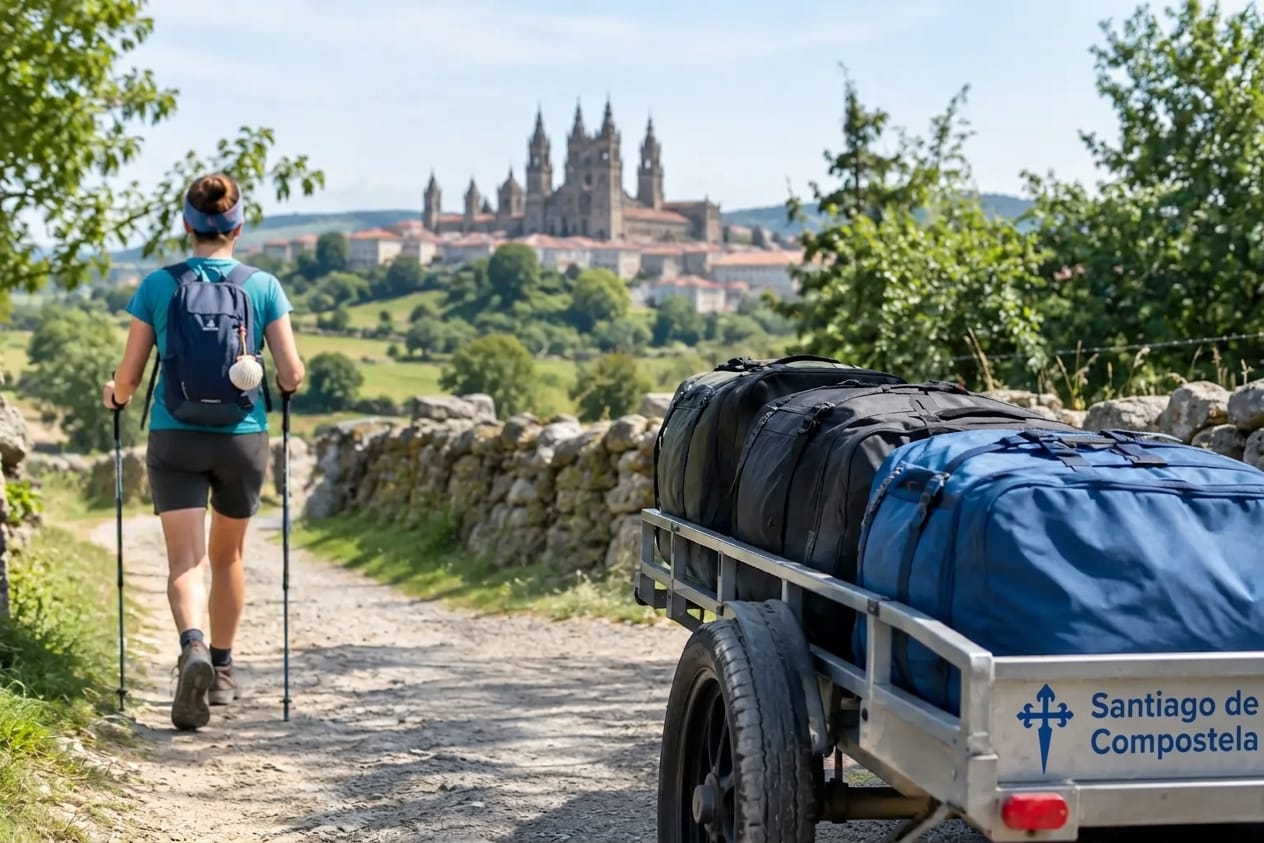
Camino luggage transfer works by moving your main bag by road from one accommodation to the next while you walk with a smaller daypack. You book the service through a local baggage-transfer company, your hotel or albergue, or sometimes your tour operator. Each morning, you label your bag, leave it at the agreed pickup point, and usually find it waiting at your next stop by afternoon.
For many pilgrims, this is the difference between walking comfortably and carrying more weight than their body can handle. It is not the only way to walk the Camino, and it may not suit everyone. But it can be a sensible option, especially on longer routes, during recovery from an injury, or when carrying a full backpack would take the joy out of the day.
What happens from one stage to the next
The exact process varies by route, provider, and accommodation, but the rhythm is usually straightforward. First, reserve the transfer for the stage or stages you need. You give the provider your current accommodation, destination, name, and bag details. Some companies accept online bookings, while others arrange transfers through a phone call, message, or your host.
In the morning, attach the supplied luggage label or your own clearly written tag. It should show your name, destination accommodation, and a contact number that works in Spain or Portugal. Leave the bag where your accommodation instructs you to leave it – commonly reception, a designated storage room, or just inside the entrance.
The driver collects bags from several properties, then delivers them along the route. Your bag may arrive before you do, or later in the afternoon if the driver has a busy delivery run. If you reach your destination and cannot see it, ask the host first. They often know whether the delivery has been made or is still expected.
What you carry yourself
Luggage transfer only works well if your daypack contains everything needed between departures and arrivals. Do not put these essentials in the transferred bag:
- Passport, pilgrim credential, bank cards, cash, and phone
- Water, snacks, sunscreen, and any medication you may need that day
- Rain gear and a warm layer, even if the morning starts clear
- Blister care, tissues, hand sanitizer, and a small first-aid kit
- Charging cable, power bank, and any reservation details
A practical daypack for a supported Camino is often much lighter than a full trekking pack. Even so, pack for the conditions rather than aiming for the smallest possible number on a scale. A cold or wet stage can be uncomfortable if your rain layer and warm clothing are in the transferred bag.
How to book Camino luggage transfer
You can arrange baggage transport one day at a time or book several stages in advance. Booking ahead brings reassurance in busy periods, particularly on popular sections of the Camino Francés from Sarria, the Portuguese Coastal Route, and routes with limited accommodation. Day-by-day booking gives more freedom if you want to shorten a stage, stay somewhere you like, or take a rest day.
Check out these luggage transport providers: Correos (Spanish Postal service) or Jacotrans
Before confirming, check four practical details: the pickup deadline, the maximum bag weight, the accepted pickup and delivery addresses, and what to do if your plans change. Providers may have different rules for private rooms, municipal albergues, rural guesthouses, and accommodations outside the usual walking line.
It also helps to tell your next accommodation that a bag is coming. This is especially useful when staying in a small casa rural, an apartment with limited reception hours, or an albergue where staff may not be present all day.
Labels matter more than pilgrims expect
A durable, easy-to-read luggage tag prevents a surprising number of problems. Write the destination’s name clearly rather than relying only on a town name, since several accommodations in one village may have similar names. Keep an additional tag inside the bag with your details in case the outer label comes off in rain or during handling.
If a provider gives you a numbered label, photograph it before you set off. That number can make it much easier to identify your bag if there is a question later in the day.
Which Camino routes have luggage transfer?
Luggage transfer is widely available on the better-traveled Camino routes, although coverage is never identical everywhere. The Camino Francés has many options, particularly between Saint-Jean-Pied-de-Port and Santiago. The Camino Portugués, including the Coastal Route, also has luggage transfer services on many stages. Parts of the Camino del Norte, Primitivo, Inglés, and Vía de la Plata can have transfer options too, but they may be less frequent or need more advance planning.
Remote stages are where assumptions can cause trouble. A provider may serve a town but not every accommodation outside it. If your planned stop is several kilometers off route, confirm that the bag can be delivered there. The same applies if you are breaking a conventional stage in an unusual place.
The service is also more common on routes with established accommodation networks. Pilgrims walking quieter, less developed, or highly flexible itineraries should be prepared to carry their own pack on some days.
Is it still a real Camino if your bag travels separately?
Yes. The Camino has always been walked for different reasons and in different circumstances. Some pilgrims carry everything, while others use luggage transfer because of physical limitations, injury recovery, limited time, or simply personal preference and others alternate between the two. There is no prize for unnecessary suffering.
That said, carrying your own gear can be satisfying. You are fully independent of pickup times, your belongings stay with you, and the daily routine feels simpler once your pack is properly fitted and pared down. Many experienced walkers prefer this approach, especially on less-served routes or when they enjoy self-sufficient hiking.
Luggage transfer has its own trade-offs. You need to plan overnight stops, meet morning deadlines, and accept that you will not have access to your main bag until later. It is best seen as a tool, not a shortcut around the pilgrimage itself. You still walk the distance, meet the weather, manage your feet, and share the path.
When baggage transport makes particular sense
Consider using a transfer service if you are returning to walking after an injury, carrying a pack that cannot be reduced safely, or facing several long stages in a row. It can also help pilgrims who want to bring a few extra layers for spring or late fall without overloading their backs.
A hybrid approach works well for many people. You might carry your pack on shorter stages and book transfers for a difficult mountain day, a 30 km stage, or the final stretch when blisters are becoming a concern. Others transfer their main bag every day but retain the option to carry it if they change plans.
There is one important caution: do not use bag transport as a reason to ignore basic fitness, footwear, or foot care. A light daypack reduces load, but it does not make steep descents, heat, or repeated long distances harmless. Build up your walking before departure with a beginner Camino training plan and respond early to pain rather than trying to push through it.
Practical tips for a trouble-free transfer
Use a sturdy bag with handles that can tolerate daily loading. A suitcase may work on smoother, town-based itineraries, but a soft duffel or backpack is usually easier for drivers to stack and carry. Keep it zipped and avoid hanging loose items from the outside.
Aim to have your bag ready the night before. Mornings on the Camino are often early, and a rushed repack is how sunscreen, medication, or a clean shirt ends up in the wrong bag. If you are using a rain cover, secure it well or place your belongings inside a waterproof liner instead.
Finally, take a quick photo of the bag and its label each morning. It is a small habit, but useful if you need to describe it to an accommodation host or transfer company.
Join The Community
Get the latest Camino guides, packing tips, and historical insights delivered to your inbox. Join a community of fellow pilgrims preparing for their journey.
Shoulder your daypack, take only what you need for the walk ahead, and let the road set the pace. Buen Camino!