
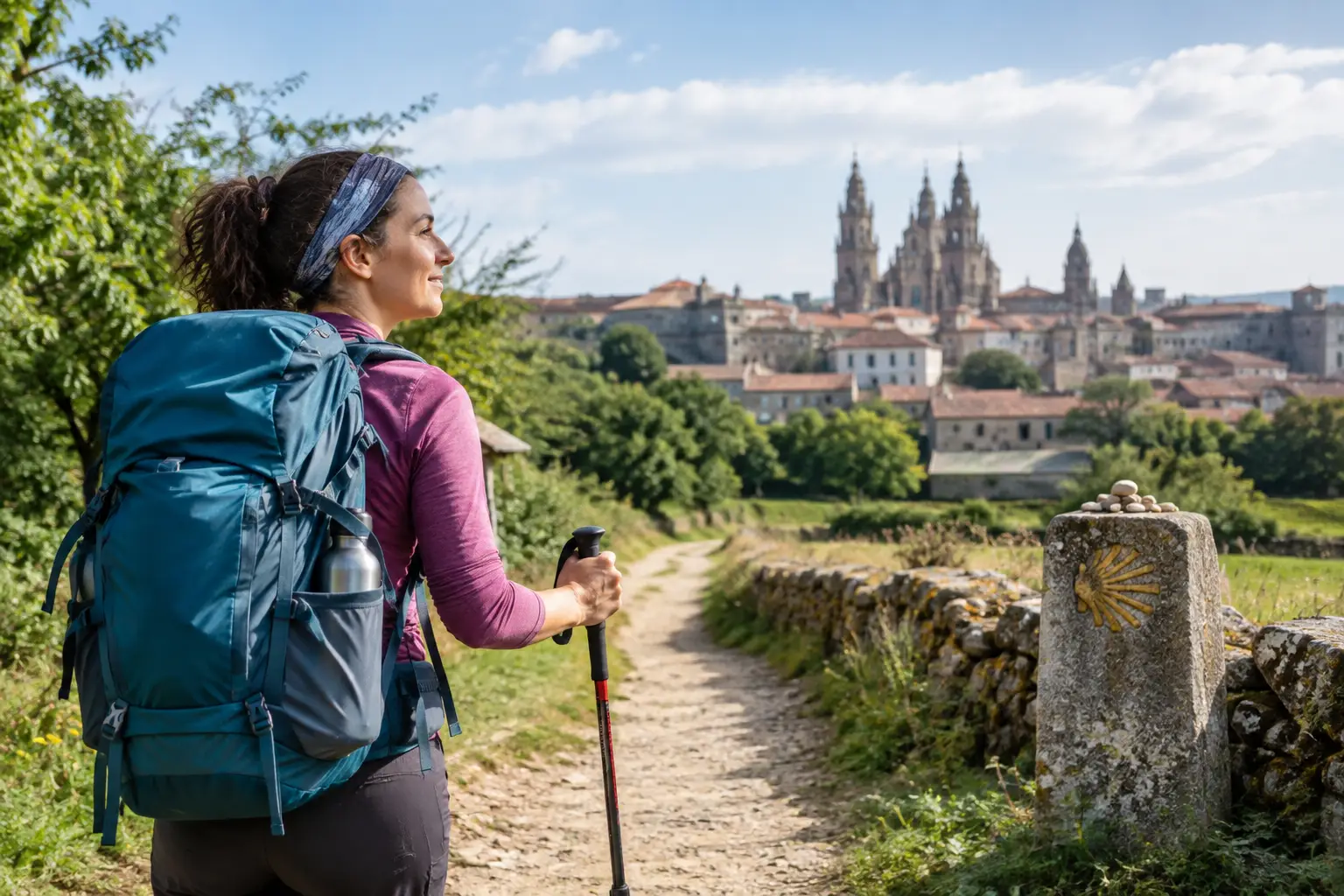
Walking the Camino alone does not mean you have to give up the social side of the pilgrimage. Solo female safety on The Camino is less about being fearful and more about making calm, repeatable choices: choosing a route and stages that suit you, knowing where you will sleep, and staying alert without losing the openness that makes the Camino special.
Many women walk the Camino de Santiago alone and find companionship when they want it. The paths, towns, albergues, and pilgrim rhythm can feel reassuringly social. But it is still a long-distance walk through unfamiliar places. Good preparation gives you more freedom to enjoy it on your own terms.
Start with the route and season
Your safest Camino is usually the one that matches your experience, fitness, language comfort, and preference for solitude. The Camino Francés has the most established pilgrim infrastructure, frequent towns, and many lodging choices. That can be helpful for a first solo walk, particularly between Saint-Jean-Pied-de-Port and Santiago, though popular sections can be busy in spring and fall.
The Portuguese Central Route also has a well-developed network of towns and accommodations. The Coastal Route can be sociable, but some variants are more spread out. On quieter routes such as the Primitivo, Norte, Inglés, or Invierno, planning ahead matters more because services may be farther apart.
Season changes the calculation. In summer, heat and crowded lodging are often the main practical concerns. In winter, shorter daylight, rain, wind, and fewer open services can create bigger safety decisions. If you are new to solo walking, avoid building a plan around late arrivals or very long, isolated stages.
Plan each day, but leave room to change it
You do not need to reserve every bed months ahead. You do need a clear idea of your next stop, realistic walking distance, and alternatives if you feel unwell or a town is full.
A sensible solo routine is to tell one trusted person your broad itinerary, accommodation name when you have one, and any major changes. Share enough information for reassurance, not a minute-by-minute report. Keep your phone charged, carry a local or international data option that works in Spain and Portugal, and save accommodation details offline.
Start walking in daylight where possible. Early starts are common on the Camino, but there is no prize for leaving before you feel comfortable. If a route section feels too quiet, wait for other pilgrims to pass, walk with someone you have gotten to know, or take a taxi for that portion. A taxi is a practical tool, not a failure of pilgrimage.
Your daily plan should include four basics:
- enough water for the next reliable refill point
- a charged phone and a small backup battery
- a rain layer or sun protection suited to the forecast
- the address and phone number of where you intend to sleep
If you are walking in Spain or Portugal, 112 is the general emergency number. Use it for urgent situations. For less urgent problems, an accommodation host, bar owner, pharmacy, tourist office, or fellow pilgrim can often help you decide what to do next.
Choose accommodation with care
Albergues are central to Camino culture and can be a warm, affordable place to meet people. They also require the normal awareness that comes with shared sleeping spaces. Read recent reviews when possible, check the location before arriving, and trust your first impression. If a place feels poorly managed or you are uncomfortable, leave if you can.
A few habits make shared accommodation easier. Keep your passport, bank cards, phone, cash, and medication in a small pouch that stays with you or is secured inside your pack. Do not leave valuables charging unattended in a common area. Use the lockers provided, but do not assume every albergue has them or that they fit a full backpack.
Private rooms in hostales, pensions, and small hotels offer more privacy, and many solo pilgrims use them occasionally to rest, recover from illness, or reset after several nights in dorms. The trade-off is cost and, in smaller towns, limited availability. Mixing albergues with private stays can be a comfortable middle ground.
If someone pressures you to change accommodation, walk a route you did not plan, or share details you would rather keep private, you do not owe them an explanation. A simple “I have plans” is enough. You can be friendly without being fully available.
Walk with awareness, not anxiety
The Camino is not a wilderness expedition, but the trail still brings ordinary risks: road crossings, loose stones, blisters that change your gait, heat exhaustion, and getting turned around after a missed arrow. Most problems are prevented by paying attention before they become dramatic.
Keep one ear free if you listen to music or podcasts. On road sections without a sidewalk, follow local pedestrian and road-safety guidance and stay alert to traffic. In fog, rain, or near dusk, make yourself visible with a light-colored rain cover or reflective detail. A small headlamp is useful even if you do not plan to walk in darkness.
Be careful about announcing that you are alone, especially in a bar, taxi, or unfamiliar conversation. You do not need to lie or become guarded with everyone. Just use the same judgment you would use at home: share personal information gradually, meet new people in public places, and notice whether someone respects ordinary boundaries.
Alcohol can change those boundaries quickly after a long day of walking. Enjoy a glass of wine if you wish, but stay aware of your surroundings, keep control of your drink, and know how you are getting back to your bed. Fatigue is also a factor. Decisions that seem easy at breakfast can feel harder when you are dehydrated and sore at 5 p.m.
Trust discomfort and act early
Your instincts are useful, but they work best when paired with practical action. If a person, place, or situation makes you uneasy, create distance early. Walk into a busy café, call your accommodation, join other pilgrims, or take a taxi onward. You do not need evidence that something is wrong before choosing caution.
The same principle applies to physical safety. Do not push through worsening pain because you feel committed to an itinerary or a group. A hot spot can develop into a blister, and persistent or worsening pain can become a bigger problem if you keep pushing through it. Take a rest day, shorten a stage, or have your backpack transported if that is what keeps you walking safely. If you use luggage transfer, carry your essentials, valuables, medication, water, and a warm layer with you. Preparing your body before departure can also help. Follow a Beginner Camino Training Plan and build your walking gradually before the trip.
Pack for independence, not for every possibility
A heavy pack can make you less stable and more exhausted, which is its own safety issue. Bring equipment that solves likely problems rather than packing out of fear. For most pilgrims, that means dependable footwear already broken in, a rain layer, sun protection, a basic first-aid kit, blister supplies, a reusable water bottle, and a small headlamp.
Find community without surrendering independence
One of the Camino’s quiet strengths is that you are rarely alone unless you choose to be. You may see familiar faces over several days, share a meal, or walk together for a morning. Let those connections develop naturally rather than feeling obliged to attach yourself to a group.
It can help to exchange numbers with one or two people you genuinely trust, especially before a remote stage or if you are feeling unwell. At the same time, preserve your right to walk at your own pace. A good Camino companion will understand that you may want company one day and silence the next.
Join The Community
Get the latest Camino guides, packing tips, and historical insights delivered to your inbox. Join a community of fellow pilgrims preparing for their journey.
The goal is not to eliminate every uncertainty. It is to be prepared enough that a wrong turn, a crowded albergue, a sudden storm, or an uncomfortable encounter becomes a manageable decision rather than a crisis. Walk attentively, accept help when it is freely offered, and remember that changing your plan is often the most confident choice you can make.
Buen Camino!