
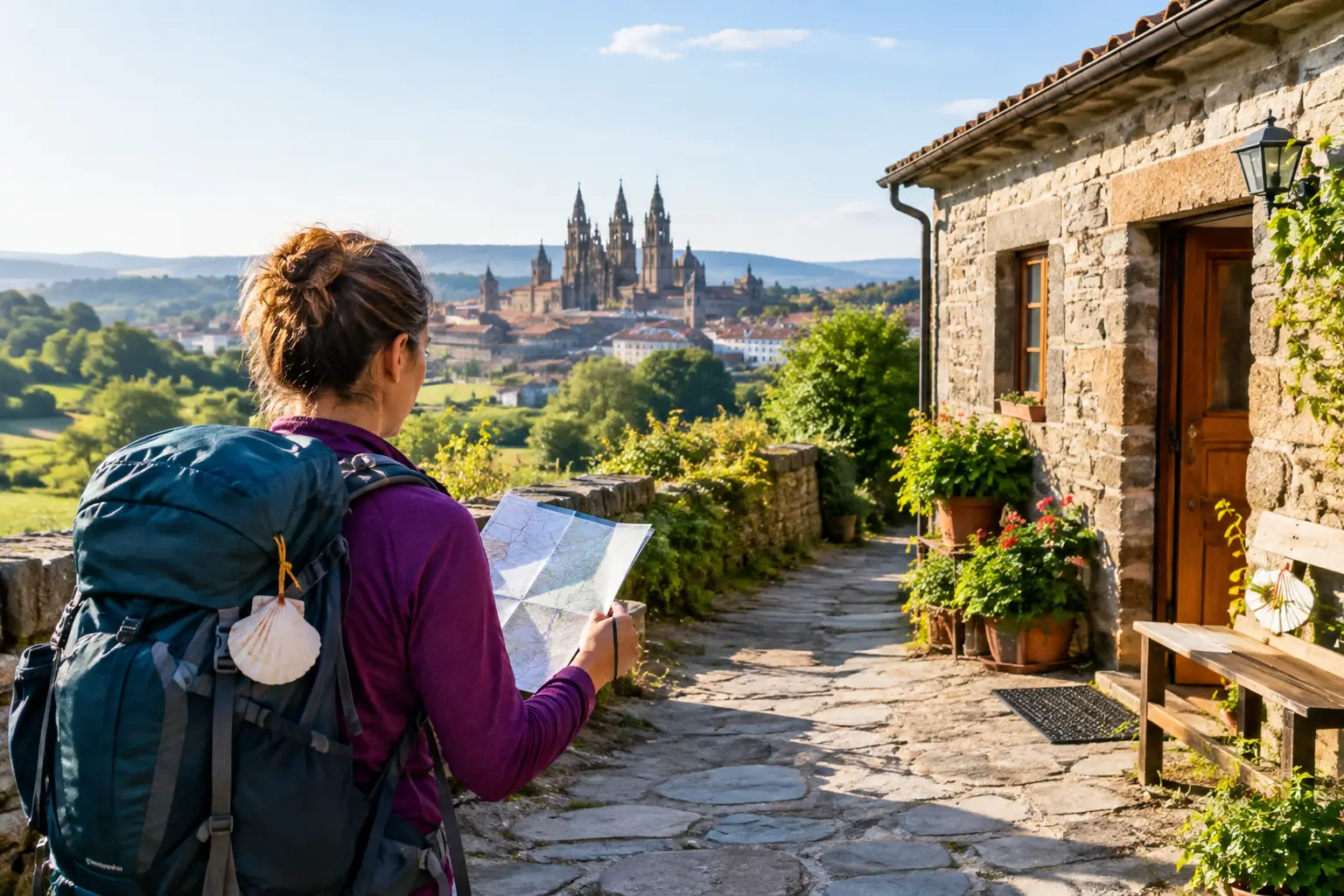
Finding a bed should support your walk, not become the main event of it. The best Camino accommodation booking tips are simple: understand the kind of place you are booking, reserve selectively on busy sections, and leave enough flexibility for the Camino to change your plans.
A fully pre-booked itinerary can bring reassurance, especially on a first Camino. But it can also make a pilgrim walk through pain, rain, or a memorable village simply because the next reservation is 24 km away. The right balance depends on your route, season, group size, and comfort with uncertainty.
Key Takeaways
- You do not need to book every night on every Camino.
- Public and municipal albergues generally do not accept advance reservations.
- Book ahead during busy seasons and on popular sections such as the final 100 km from Sarria.
- Reserve earlier if you need a private room, accessible accommodation, or are travelling with a group.
- Check the distance, terrain, cancellation terms, and check-in arrangements before committing.
- Never let a reservation force you to walk beyond your physical limits.
Know your Camino accommodation options
Most pilgrims stay in albergues, the shared hostels associated with the Camino. They range from basic dormitories to modern hostels with private rooms, laundry facilities, kitchens, and luggage storage. The atmosphere can be communal and lively, although a good night’s sleep is never guaranteed.
Municipal and other public albergues are usually simple, pilgrim-focused, and generally do not accept advance reservations. Beds are commonly allocated on arrival, making them an affordable and traditional choice, but facilities and rules vary by location. Some give priority to pilgrims travelling on foot or by bicycle with a credential.
Parish or donation-based albergues may offer a quieter, more reflective experience, often with a shared meal or an evening welcome. They are not hotels, and they work best when approached with patience and respect for the volunteers and house rules.
Private albergues usually offer the greatest choice of booking methods and amenities. Many have dorm beds, private rooms, or both. A pension, guesthouse, hotel, or rural house may be a better fit when you need recovery sleep, are traveling with a partner, or simply want a room of your own after several nights in a dorm.
| Accommodation | Bookable? | Best for |
|---|---|---|
| Public or municipal albergue | Usually no | Traditional, low-cost Camino experience |
| Private albergue | Often yes | Pilgrims wanting flexibility and more choice |
| Pension or guesthouse | Usually yes | Private rooms, couples, and recovery nights |
| Hotel or rural accommodation | Usually yes | Extra comfort, rest days, and families |
Choose for the stage, not just the town
A bed in the most famous stop is not always the wisest choice. On the Camino Francés, for example, a town can become crowded because guidebooks present it as the standard endpoint. Walking 3-5 km farther, or stopping a little earlier, may mean a calmer village and a more manageable day tomorrow.
Look at the next two days in front of you. Consider hills, exposed terrain, your likely walking pace, meal options, and whether the following village has enough services. A short stage before a demanding climb can be more valuable than a perfectly spaced daily distance.
When to book ahead on the Camino
Booking every night can make sense for some pilgrims, particularly those walking during Easter week, late spring, summer, or on popular final sections into Santiago. The final 100 km from Sarria on the Camino Francés are particularly popular and can become busy during peak periods, as can popular sections of the Portuguese Camino and coastal routes during holiday periods.
It is also wise to reserve ahead if you are travelling as a family, a group of friends, or with a dog, although you should always confirm that the accommodation accepts pets. Booking ahead is also sensible if you need a private room, accessible accommodation, or a specific rest-day location.
For a solo walker in a quieter season, booking one or two nights ahead often offers enough security without turning the pilgrimage into a fixed schedule. A useful middle ground is to reserve the first night, any key busy-night stays, and your arrival night in Santiago, then decide the rest as you walk.
Do not book beyond your body
Many first-time pilgrims plan consecutive 20-30 km days before they know how their feet, knees, or shoulders will respond. Blisters, heat, a poorly fitted pack, and unexpected fatigue can change a plan fast. Make reservations you can realistically reach, and favor rates with understandable cancellation terms when possible.
If you have a long transfer before starting, book that first night and avoid building a demanding first walking day around a late arrival. Beginning rested is more useful than saving a few euros or forcing yourself to match an itinerary.
A practical booking routine
The easiest approach is to make accommodation a short daily task rather than an all-day concern. Once you know how far you have comfortably walked for a few days, your decisions become much better informed.
Use this routine:
- In the late afternoon, decide whether tomorrow’s stage has a busy destination, a limited number of beds, or few alternative villages.
- Check the distance and terrain before reserving. A flat 25 km day and a hilly 25 km day are not the same commitment.
- Confirm what you are booking: a dorm bed or private room, check-in hours, bedding, meals, laundry, and whether payment is due online or on arrival.
- Save the address, phone number, confirmation details, and cancellation policy offline. Mobile signal and battery life are not always reliable when you need them.
- If plans change, cancel as early as you can. A timely cancellation may help another tired pilgrim find a bed.
Calling or messaging directly can be useful in small villages, especially when online information appears unclear. Keep the message brief and polite. State your name, arrival date, number of people, and whether you need a dorm bed or private room.
Read the details that affect sleep
A listing may look ideal until you notice that check-in ends early, towels cost extra, or the dormitory has 30 beds. None of these details is necessarily a problem, but they matter after a long walking day.
Before booking, check whether the property provides sheets or requires a sleeping bag liner, whether there are lockers, and whether breakfast is available early enough for your departure. If you are carrying luggage through a transfer service, confirm the delivery procedure with both the accommodation and the carrier.
Earplugs and an eye mask take up almost no space and can make a shared dorm far more manageable. A light layer for sleeping is useful too, since indoor temperatures and bedding vary. Keep your sleeping clothing clean and separate from the damp gear you walked in.
Respect the albergue rhythm
Albergues are shared spaces, not just inexpensive beds. Arrive during stated check-in hours, keep your gear compact, shower efficiently when facilities are busy, and prepare for early movement in the morning. Pack most of your bag the night before so you are not searching for socks at 6:00 a.m.
Quiet hours are worth taking seriously. People may be recovering from a difficult stage, dealing with an injury, or starting before sunrise. The Camino is social, consideration is part of the culture.
Avoid the two common booking mistakes
The first mistake is assuming every Camino town has abundant accommodation. Some smaller places have only a few options, and closures or limited seasonal opening dates can alter the picture. Carry enough water and food for the day, and know the next realistic stopping point before you set out.
The second is treating a reservation as more important than your health. If you develop sharp pain, feel unwell, or arrive dangerously exhausted, stop and reassess. Losing a deposit is frustrating; worsening an injury can end the walk. A taxi for the final few kilometers, an unplanned rest day, or a change of stage is sometimes the sensible pilgrim decision.
Keep room for the Camino itself
Accommodation planning works best when it is quiet preparation rather than constant control. Reserve when demand, personal needs, or peace of mind call for it. Stay flexible when your body, the weather, or a place worth lingering in suggests another plan.
Join The Community
Get the latest Camino guides, packing tips, and historical insights delivered to your inbox. Join a community of fellow pilgrims preparing for their journey.
The bed you remember most may not be the one with the best review. It may be the modest albergue where someone shared advice, where you finally slept deeply, or where you realized you did not need to know every detail of tomorrow. Buen Camino!