
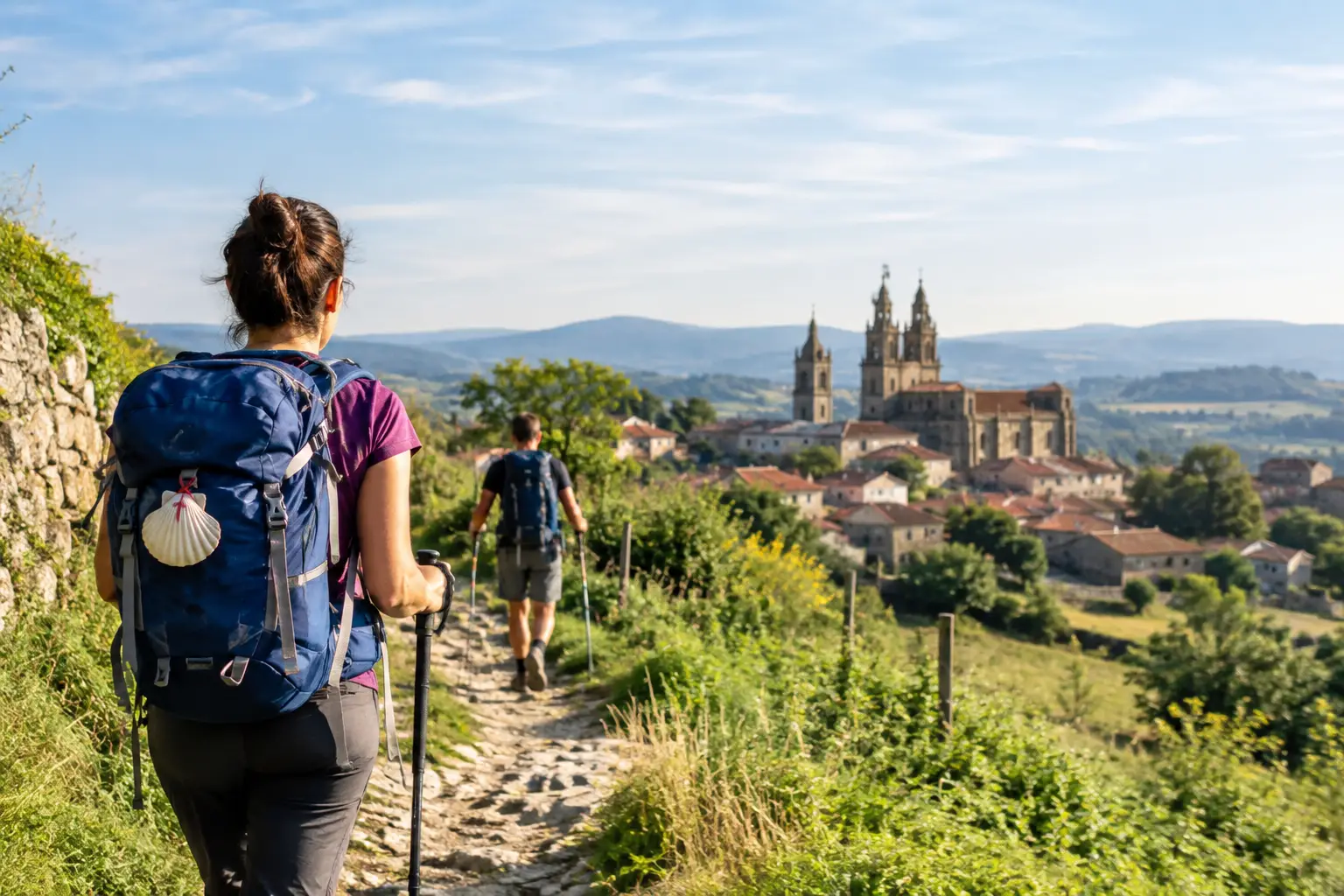
Camino route difficulty is not simply a question of how many kilometers you will walk. For most first-time pilgrims, the Camino Francés offers the most forgiving balance of waymarking, towns, accommodation, and daily flexibility. But that does not make every section easy. The right route is the one whose terrain, season, and daily rhythm fit your own preparation.
What Determines Camino Route Difficulty?
Distance matters, but it is only one part of the picture. A 20 km day on flat ground with frequent cafés is very different from 20 km over rough mountain paths in hot weather.
Terrain and elevation
Climbing is the obvious challenge, but long descents can be just as demanding. They place repeated pressure on knees, toes, and quads, especially when carrying a pack. Rocky surfaces, loose gravel, mud, and uneven forest trails also slow the pace and require more concentration than a smooth track.
The Camino Francés includes serious climbs and descents, particularly around the Pyrenees, Alto del Perdón, Cruz de Ferro, and the descent to Molinaseca. The Camino Primitivo has more sustained hills and rugged sections. By contrast, much of the Camino Portugués Coastal is relatively level, although wind, rain, and sand can add their own fatigue.
Daily distances and recovery time
A route becomes harder when your planned stages leave no room for a slow day, a blister, or a change in weather. Walking 25 to 30 km every day may be manageable for an experienced hiker, but it can quickly become a strain for someone new to consecutive-day walking.
The Camino works best when you can adjust. An extra night in a town, a shorter stage after a hard climb, or a rest day when needed can prevent a small discomfort from becoming an injury. Choosing a route with frequent villages gives you more of those options.
Weather and season
The same route can feel entirely different in April, July, or October. Summer heat can make open sections of the Meseta or the Vía de la Plata especially demanding. Winter brings shorter daylight, cold, rain, and the possibility of snow or route closures in higher areas.
Shoulder seasons often offer more moderate walking temperatures, but they can also bring persistent rain and muddy paths, particularly in Galicia and northern Portugal. Check seasonal conditions before committing to a route, and pack clothing that can handle changing conditions rather than relying on one forecast.
Services, navigation, and solitude
Frequent cafés, grocery stores, pharmacies, albergues, and clear yellow arrows make a route feel more accessible. The Camino Francés is the strongest choice on this front.
Less-traveled routes can be deeply rewarding, but they require greater self-sufficiency. On the Vía de la Plata, Camino Sanabrés, or quieter parts of the Camino de Invierno, services may be farther apart and accommodation choices fewer. A phone, offline maps, water capacity, and a willingness to plan ahead matter more there.
Camino Route Difficulty Compared
No route can be reduced to a single rating, but these broad comparisons can help you narrow your choice.
| Camino Route | Overall Difficulty | Main Challenge | Best Suited To |
|---|---|---|---|
| Camino Portugués | Easy–Moderate | Rolling terrain, pavement, weather and urban walking | First-time pilgrims and walkers wanting a manageable route |
| Camino Inglés | Moderate | Frequent climbs and descents over a short distance | Fit beginners and pilgrims with limited time |
| Camino Francés | Moderate | Mountain sections, long stages and changing terrain | First-time pilgrims wanting the classic Camino experience |
| Camino del Norte | Moderate–Challenging | Repeated coastal climbs, descents and wet weather | Walkers comfortable with varied terrain |
| Vía de la Plata | Moderate–Challenging | Long distances, heat, exposed terrain and fewer services | Experienced, self-reliant pilgrims |
| Camino Primitivo | Challenging | Sustained climbs, descents, uneven terrain and variable weather | Experienced walkers who enjoy hills and quieter trails |
Important: These difficulty ratings are broad guides, not official classifications. A route can feel considerably harder or easier depending on your fitness, pack weight, daily distance, weather, and the specific stages you choose.
Camino Francés: best for first-time pilgrims
The Camino Francés is physically varied but logistically straightforward. Its popularity means plentiful accommodation, strong waymarking, and many places to stop, eat, refill water, or shorten a day. This is a major advantage when you are learning how your feet and body respond to walking day after day.
Its difficult moments are real. The first Pyrenees stage from Saint-Jean-Pied-de-Port is particularly demanding, while sections around León, O Cebreiro, and Galicia can test tired legs. However, the route offers enough accommodation and stage flexibility for many pilgrims to adapt their daily distances. For that reason, the Francés is often a manageable choice overall, even though individual stages can be strenuous.
Camino Portugués: generally gentler, with choices
The Central Route from Porto has rolling terrain, city walking, rural paths, and good services. It is often considered one of the more manageable long-distance Caminos, especially if you begin in Porto rather than walking the full route from Lisbon.
The Coastal Route can be flatter in some sections and offers boardwalks and Atlantic views, but it is not completely flat. Wind, rain, hard surfaces, and occasional climbs can add fatigue. The Central and Coastal routes also vary considerably by stage, so individual daily profiles still deserve attention.
Camino Inglés: short, but not necessarily easy
The Camino Inglés is a practical option for pilgrims with limited time, usually walked from Ferrol or A Coruña. Starting in Ferrol it is about 113 km, while the shorter A Coruña option is significantly shorter. The compact distance can tempt people into rushing it.
It has plenty of rolling hills, and the frequent ups and downs can surprise walkers who expected an easy final-week Camino. It is a good choice for a fit beginner with five to seven days, provided they plan sensible stages rather than trying to finish as quickly as possible.
Camino Primitivo: demanding and rewarding
The Camino Primitivo from Oviedo is often described as one of the tougher major routes. Its appeal lies in Asturias and Galicia’s mountain landscapes, quieter trails, and strong sense of remoteness. Its challenge lies in repeated climbing, descending, variable weather, and sections where daily planning deserves more care.
This route suits walkers who are comfortable with hills, have trained on uneven ground, and do not need every day to offer many accommodation options. You do not need to be an elite athlete, but you should arrive with strong walking fitness and enough time to take shorter stages when necessary.
Camino del Norte: moderate to challenging
The Camino del Norte follows Spain’s northern coast from the Basque Country toward Galicia. It offers beautiful scenery and vibrant cities, but its constant coastal undulations can be tiring. Several days include steep slopes between sea level and hilltop villages, while pavement can be hard on feet and joints.
It is best for pilgrims who enjoy varied terrain and are prepared for wetter weather. Compared with the Francés, it generally asks more of your legs and your planning, though it is not as consistently mountainous as the Primitivo.
Vía de la Plata and Camino Sanabrés: hard through scale and heat
The Vía de la Plata is not difficult because of dramatic mountain terrain alone. Its main challenge is scale: long stretches, broad open landscapes, fewer services, and potentially severe heat in warmer months. It rewards patient, self-reliant pilgrims who can carry enough water and adapt plans when accommodation is limited.
The Camino Sanabrés, a common continuation toward Santiago, adds more climbing and changing weather. These routes are better approached as a longer-term project than a first test of whether you enjoy pilgrimage walking.
Match the Route to Your Real Preparation
The most useful question is not, “Which Camino is easiest?” Ask what kind of difficulty you handle well. Someone accustomed to hillwalking may prefer the Primitivo but struggle with hot, exposed stages. Someone who walks regularly on pavement may find the Portuguese routes comfortable but feel uncertain on rocky descents.
Before choosing, try several consecutive walks with the shoes, socks, and pack you intend to use. Build toward carrying your expected load, ideally keeping it light enough that you can walk naturally rather than leaning forward under the weight. Practice on hills if your route includes them, and include a downhill section if possible.
Your clothing also affects how hard a day feels. A breathable layer for warm climbs, a warm layer for stops, and reliable rain protection are more useful than a large wardrobe. Comfortable Camino-inspired clothing from Buen Camino Store can be a good reminder of the journey ahead, but on the trail, fit, layers, and weather readiness always come first.
A Sensible Way to Choose
If you want the easiest route to organize and the most flexibility, choose the Camino Francés. If you prefer a generally gentler profile and a shorter overall walk from Porto, consider the Camino Portugués. If you have limited time but are ready for rolling terrain, the Camino Inglés is a strong option.
Choose the Primitivo or del Norte when hills, variable weather, and a more demanding walking experience are part of the reason you want to go. Choose the Vía de la Plata when you have time, enjoy quieter routes, and are prepared to be more independent.
Join The Community
Get the latest Camino guides, packing tips, and historical insights delivered to your inbox. Join a community of fellow pilgrims preparing for their journey.
Start with a route and pace that leave room to notice the villages, share a meal with other pilgrims, and arrive in the evening with enough energy to enjoy where you are. That is often the best measure of whether the route is right for you. Buen Camino!