
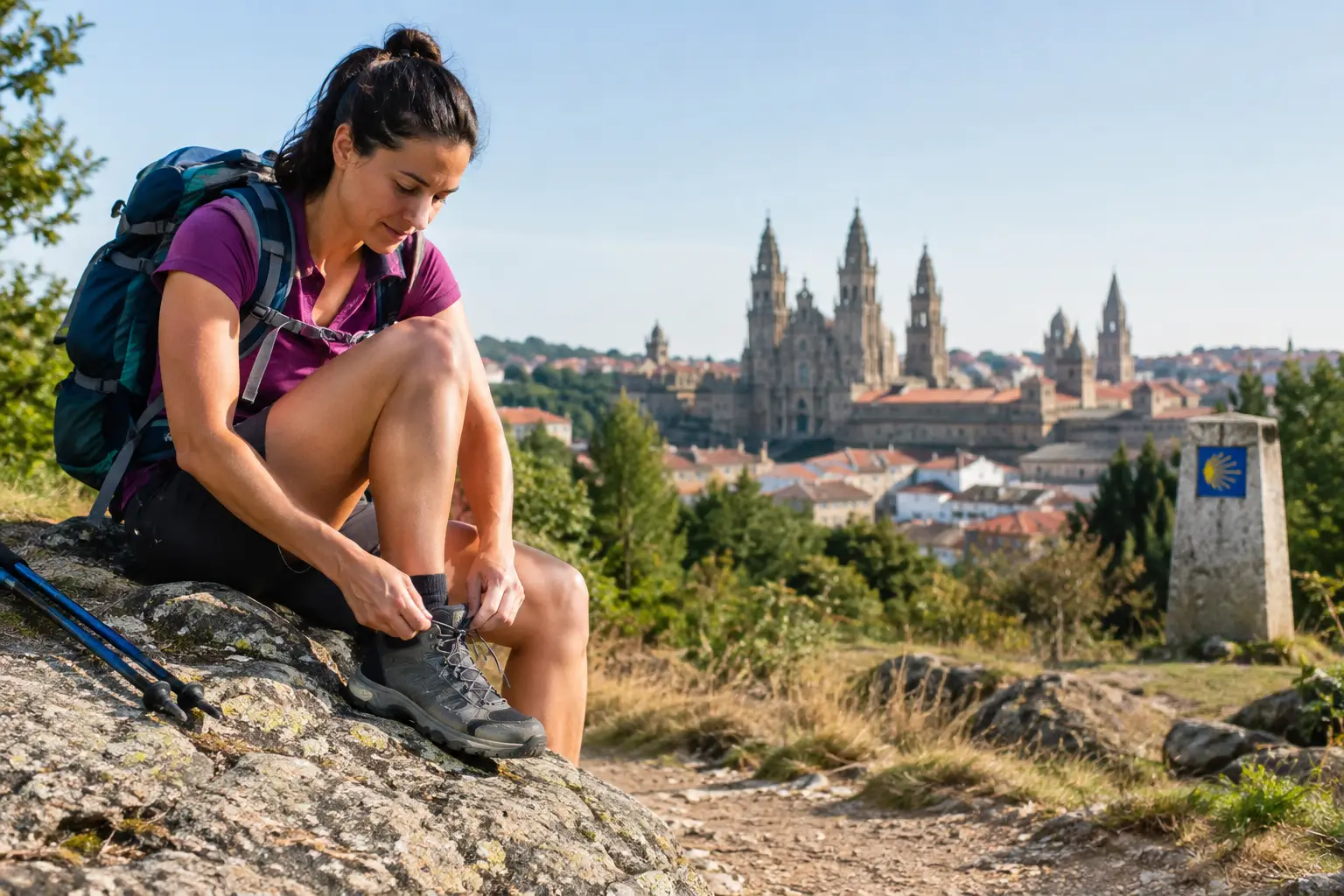
The best shoes for Camino walking are the pair that fit your feet well, feel proven after long days, and match the surfaces and weather of your route. For many pilgrims, that means lightweight trail runners. For others, especially those carrying more weight or walking rougher mountain sections in cool, wet conditions, it may mean low hiking shoes or boots. There is no single Camino shoe that works for every person.
Your feet will carry you through village streets, gravel tracks, forest paths, muddy descents, and long stretches of pavement. Choose for the walking you will actually do, not for the most dramatic photo of the Camino.
| Footwear type | Best suited to | Main trade-off |
|---|---|---|
| Trail runners | Warm weather, mixed paths and long walking days | Less foot protection and ankle coverage |
| Low hiking shoes | Walkers who prefer a firmer sole and more protection | Can feel heavier or stiffer than trail runners |
| Mid-height hiking boots | Rougher terrain and cool, wet conditions, if they fit well | More weight and potentially slower drying |
| Waterproof footwear | Cool, wet weather and persistent rain | Can retain heat and dry slowly if water gets inside |
Tip: Waterproofing is a feature, not a separate footwear category. Choose it according to the season, weather and how your feet respond to heat and moisture.
Start with fit, not the label
A shoe can have excellent traction, cushioning, and weather protection, then still become a problem if the fit is wrong. On a multiweek walk, small pressure points can turn into blisters, black toenails, or pain that changes the way you walk.
Try shoes on later in the day, when feet are naturally a little larger. Wear the socks you intend to walk in, and bring any insoles or orthotics you normally use. Your toes should have room to spread and move, particularly downhill, without your heel lifting on each step.
A useful check is to stand with your full weight on the shoe and make sure there is roughly a thumb’s width of space in front of your longest toe. This is a guide, not a rule. Some feet need more room, especially if they swell noticeably in warm weather.
Pay attention to these fit issues before you buy:
- Heel slip can cause friction at the back of the foot.
- Tightness across the forefoot can create hot spots or numb toes.
- A shallow toe box may lead to bruised toenails on descents.
- Arch support should feel comfortable rather than aggressively corrective.
Do not assume you must buy a bigger size simply because you are walking the Camino. Sizing varies widely by brand and model. The right choice is the size that leaves toe room while holding your heel securely.
Trail runners are often the best shoes for Camino routes
Trail runners are a popular choice for many Camino pilgrims. They are usually lighter than hiking boots, often dry faster after getting wet, and can feel comfortable over repeated days of walking. For many people on established Camino paths, a well-fitting trail runner with suitable cushioning and grip is a practical option. However, foot shape, pack weight, terrain, weather and personal preference all affect the best choice.
They are particularly well suited to the Camino Francés in late spring, summer, or early fall, when dry tracks and long paved approaches are common. The Portuguese Camino, including coastal routes, can also suit trail runners well, though wet cobblestones, boardwalks, and muddy sections call for a reliable outsole.
Look for a trail runner with moderate cushioning, a stable heel, and lugs that grip loose dirt without feeling awkward on pavement. Very deep, aggressive lugs are useful for mountain mud but can feel harsh and wear quickly on long asphalt sections.
The trade-off is less ankle coverage and less protection from persistent rain. However, many pilgrims find that a wet, breathable trail runner dries more quickly than a waterproof shoe that has become soaked from the inside.
When hiking shoes or boots make more sense
Low hiking shoes are a sensible middle ground. They often offer a firmer sole, better protection around the foot, and more structure than trail runners without the weight of a high boot. They can work especially well if you prefer a stable platform or carry a heavier backpack.
Mid-height boots can be useful on routes with more sustained mountain terrain, such as parts of the Camino Primitivo, Camino del Norte, or the approach to O Cebreiro on the Francés. They may also suit pilgrims walking in colder shoulder-season weather, when puddles, mud, and cold rain are more likely.
That said, ankle-high boots do not automatically prevent sprains. Good foot placement, a measured pace on descents, and strength in the ankles matter more. A stiff, heavy boot can also make hot feet and fatigue worse if you are walking mostly road and compact trail.
Choose boots because they genuinely feel better for your body and route, not because you think pilgrims are supposed to wear them.
Waterproof or breathable: choose for your season
Waterproof membranes can be valuable in cool, wet conditions. They help keep out rain, shallow puddles, and wet grass, and they can add warmth on chilly mornings. For a spring or fall Camino in northern Spain, that protection may be welcome.
But waterproof shoes have limits. Water can still enter from the top during heavy rain, stream crossings, or deep puddles. Once wet inside, they often take much longer to dry than non-waterproof footwear. In summer heat, they can also trap warmth and sweat.
For a warm-weather Camino, many experienced walkers prefer breathable mesh trail runners and accept that their feet may get wet occasionally. They dry overnight more reliably when you remove the insole, loosen the laces, and place them in a ventilated spot. Never place shoes directly against a strong heat source, which can damage glue and materials.
A practical compromise is to select breathable shoes with a quick-drying upper, then carry lightweight rain protection for the rest of your body. Dry socks in your pack matter more than trying to guarantee dry shoes every day.
Match your footwear to the route and daily distance
The Camino is not one surface. Even within the same route, conditions change with weather, detours, and the path you choose between towns.
On the Camino Francés, expect a mix of gravel, dirt, stone, and pavement. Long paved days around towns and on some Meseta stages reward cushioning and a shoe that does not feel overly rigid. The climb and descent around O Cebreiro require dependable grip, especially in rain.
The Portuguese Coastal Camino often includes pavement, promenades, boardwalks, sand, and cobbled streets. Cushioning and secure traction are more useful than heavy ankle support for most walkers. On the Central Route, stone paths and wet urban surfaces can be slippery, so inspect the outsole rather than choosing based on appearance.
The Camino del Norte and Primitivo are generally more demanding underfoot, with steeper gradients and more uneven trail. A supportive trail runner or hiking shoe can be a strong choice here. If you already know boots work well for you in wet hills, this may be the route where they earn their extra weight.
Break in the shoe, but do not wear it out
New shoes should not make their first serious outing on day one in Saint-Jean-Pied-de-Port, Porto, Oviedo, or anywhere else. Wear them on local walks before departure, gradually building up to consecutive days and at least one walk close to your expected Camino distance.
This is not about making a shoe soft through misery. Modern trail runners usually need little traditional break-in. The goal is to identify rubbing, heel movement, lace pressure, or sock problems while you can still change the setup.
Test your full system: shoes, socks, insoles, backpack weight, and the way you lace your shoes. Walk hills if possible. A pair that feels perfect for 5 km on level ground may behave differently after 18 km downhill with a loaded pack.
For additional preparation advice, consult the official Galician Camino de Santiago guidance on physical and mental preparation.
Socks, lacing, and foot care matter as much as shoes
The shoe is only one part of keeping your feet healthy. Choose walking socks that fit closely, manage moisture, and do not bunch at the toes. Merino-blend or synthetic hiking socks are common choices. Bring enough pairs to rotate them, wash them, and always have a dry pair available.
Adjust lacing during the day as your feet change. A heel-lock lacing method can reduce heel movement, while loosening the forefoot slightly may relieve pressure when feet swell. Stop at the first sign of a hot spot rather than waiting for a blister to form. Dry your feet during breaks when practical, and inspect them each evening.
If you use poles, practice with them before the Camino. They can reduce strain on descents and help with balance, but only if they do not disrupt your natural rhythm.
A simple way to make the final choice
If you are undecided between two suitable pairs, favor the one that has already performed well on your own feet. A familiar trail runner is usually a better Camino companion than a technically impressive boot bought a week before departure. Bring footwear that lets you notice the churches, fields, conversations, and yellow arrows rather than every step beneath you.
Join The Community
Get the latest Camino guides, packing tips, and historical insights delivered to your inbox. Join a community of fellow pilgrims preparing for their journey.
The right shoes will not make the Camino effortless, but they will give your feet the best chance to carry you comfortably toward the next town. Buen Camino!