
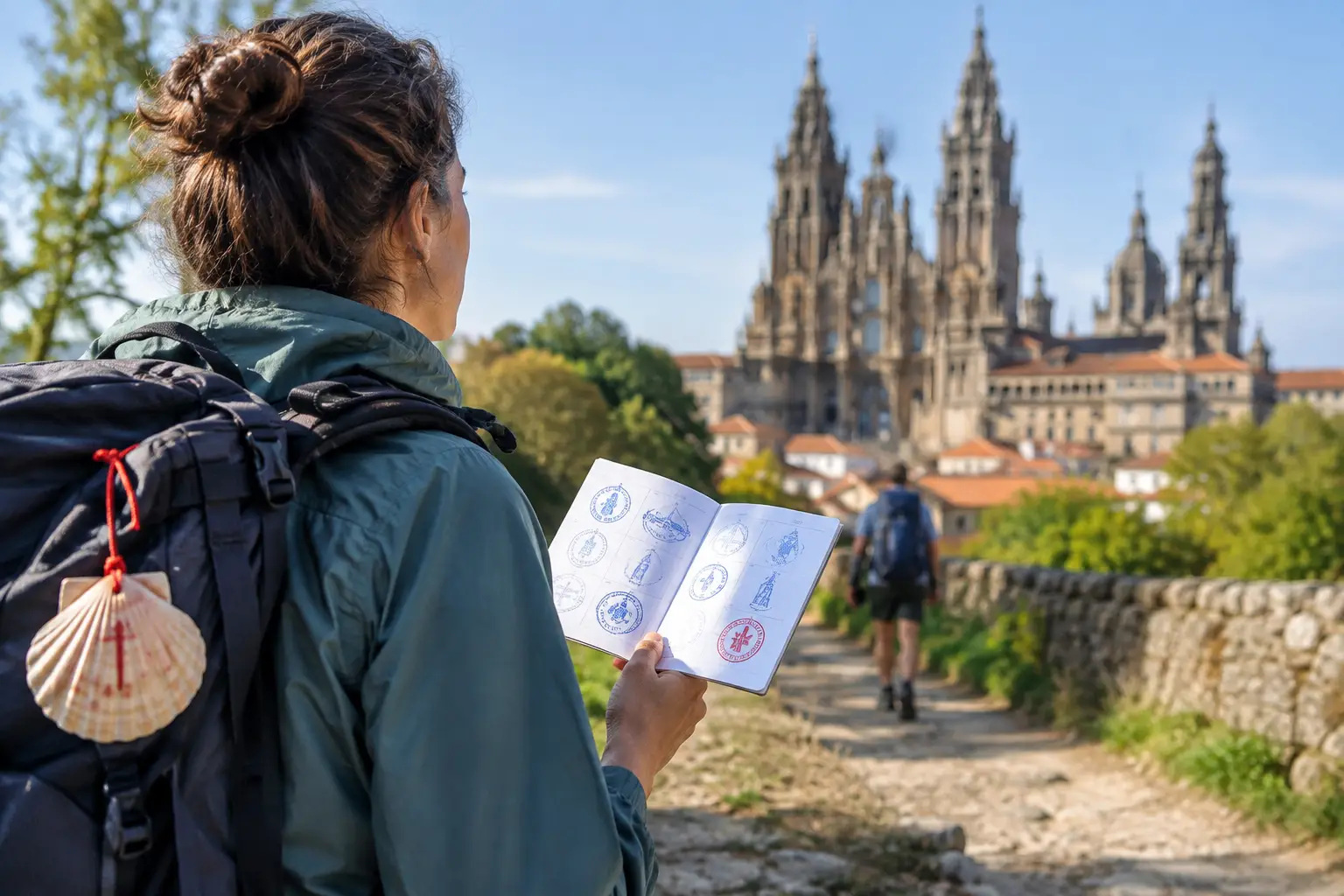
If you are searching for Camino passport requirements, you may mean one of two different documents: the passport you need to enter Spain and the pilgrim passport, properly called the Credencial del Peregrino. They serve completely different purposes. Your travel passport gets you to the Camino; your credential records the pilgrimage and may allow you to request a Compostela in Santiago.
For most pilgrims, the credential is simple to arrange. The details that matter are carrying the right one, collecting stamps carefully, and understanding what the Cathedral’s Pilgrim Office asks for if you hope to receive the Compostela.
The Camino pilgrim passport: your credencial
The credencial is a folded pilgrim record book with spaces for stamps, known in Spanish as sellos. It is not an identity document, a visa, or a reservation card. It is evidence that you have traveled the Camino as a pilgrim.
You can usually obtain one before leaving home through an authorized Camino association in your country. This is often the calmest option, especially if you are beginning from a smaller village where supplies may be limited. You can also get a credential at many route starting points, pilgrim offices, churches, hostels, and some albergues. Availability varies, so do not assume every accommodation will have one.
Bring your actual passport or another government-issued photo ID as well. Albergues and other accommodations in Spain commonly need to register guests, and your credencial does not replace identification.
What the credential is used for
The credencial has three practical roles. It provides the stamp record used when applying for the Compostela, can help identify you as a pilgrim at pilgrim-specific accommodations, and becomes a personal record of the places and communities that shaped your walk.
Do not treat it as a race card. There is no prize for filling every empty square, and a page crowded with stamps does not make a pilgrimage more authentic. A well-kept credential with a sensible record of your route is enough.
Camino passport requirements for the Compostela
The Compostela is the traditional certificate issued in Santiago de Compostela to pilgrims who complete the required distance with a religious or spiritual motivation. The Pilgrim Office reviews your credential and asks you to state your motivation when you request it.
To qualify, the standard minimums are:
- At least the final 100 km on foot or on horseback.
- At least the final 200 km by bicycle.
- The qualifying distance must be completed on an officially recognized Camino route and continue to Santiago de Compostela.
- A Credencial with the required stamp record, particularly throughout the final qualifying distance.
For walkers, that final 100 km is why Sarria is such a common starting point on the Camino Francés. Its distance to Santiago is just over the qualifying threshold. Tui is a popular starting point on the Portuguese Way, while Ferrol is a common Camino Inglés starting point for pilgrims walking the full qualifying distance.
The distance rule is only one part of the requirement. Walking 100 km somewhere in Spain, then traveling to Santiago, does not qualify. The Camino must be completed continuously on the route, using the credential to show the journey.
How many stamps do you need?
Collect at least two stamps per day during the final 100 km on foot or horseback, or during the final 200 km by bicycle. This is the clearest way to meet the Pilgrim’s Office requirements and demonstrate your progress toward Santiago.
Earlier in a longer pilgrimage, one stamp per day is generally a sensible record. If you start in Saint-Jean-Pied-de-Port, Porto, Seville, or another distant starting point, your credential will naturally fill as you go. There is no practical need to chase stamps at every café.
Good places to collect them include albergues, parish churches, hotels, municipal offices, tourist offices, cafés, museums, and Camino information points. Get one when you begin walking and another later in the day, ideally where you stop for the night. A date beside the stamp is helpful, so check that it is readable before you leave the counter.
If a church is closed or a small village has no obvious stamp, do not panic. Use the next legitimate stop.
What if you walk for nonreligious reasons?
Many people walk the Camino for reflection, recovery, cultural interest, or the challenge of a long journey. Those reasons are valid. However, the traditional Compostela is intended for pilgrims who state a religious or spiritual motivation.
If your motivation is not religious or spiritual, ask at the Pilgrim Office about the alternative certificate available for completing the route. Do not misrepresent your reasons simply to receive a particular document. The Camino has room for many kinds of travelers, and honesty is part of respecting its tradition.
Travel passport and entry requirements for Spain
For many non-EU visitors, Spain applies the Schengen rules. Travelers from visa-exempt countries can commonly stay up to 90 days in any 180-day period across the Schengen Area, but that does not apply equally to every nationality or situation.
As a practical precaution, make sure your passport is in good condition and has sufficient blank pages for your journey. Many visitors must meet the Schengen passport validity standard of having at least three months left after their planned departure from the area, and having been issued within the previous 10 years. Your nationality can affect the exact rules.
Carry copies, but protect the original
Keep your travel passport secure and separate from your credential. A lightweight zip pouch or money belt can work well while walking, but do not bury it so deeply that you cannot produce it at an accommodation check-in.
Carry a paper copy and a secure digital copy of the photo page, travel insurance details, and emergency contacts. Copies make a lost passport easier to replace, but they are not valid for crossing borders or checking into every accommodation. If your passport is lost or stolen, contact your embassy or consulate and make a police report as soon as possible.
A simple credential routine on the Camino
A little routine prevents most credential problems. Each morning, put the credencial in a waterproof sleeve inside your daypack. At your overnight stop, get a dated stamp, then place it back in the same pocket rather than on a table or bedside shelf.
During the last 100 km, collect two stamps each walking day. One could come from your morning departure point and one from your accommodation, church, or café later on. This is easier than trying to find two stamps when you are tired and the village is closing for the afternoon.
Avoid folding the credential repeatedly, leaving it in wet clothes, or handing it to strangers without watching where it goes. It is a small paper booklet, but it represents days or weeks of effort.
Before you arrive in Santiago
Keep walking until you reach Santiago de Compostela, then visit the Pilgrim Office with your credential and identification. Expect the process to take longer during busy seasons, especially after late morning. Your credential will be checked, and you can request the certificate appropriate to your journey and stated motivation.
Important: If you want to qualify for the Compostela, use the official Credencial issued by the Cathedral of Santiago or one issued by an organisation authorised by the Cathedral.
Join The Community
Get the latest Camino guides, packing tips, and historical insights delivered to your inbox. Join a community of fellow pilgrims preparing for their journey.
Protect the credential, follow the rules honestly, and let it become what it is meant to be: a modest record of a real Camino. Buen Camino!