
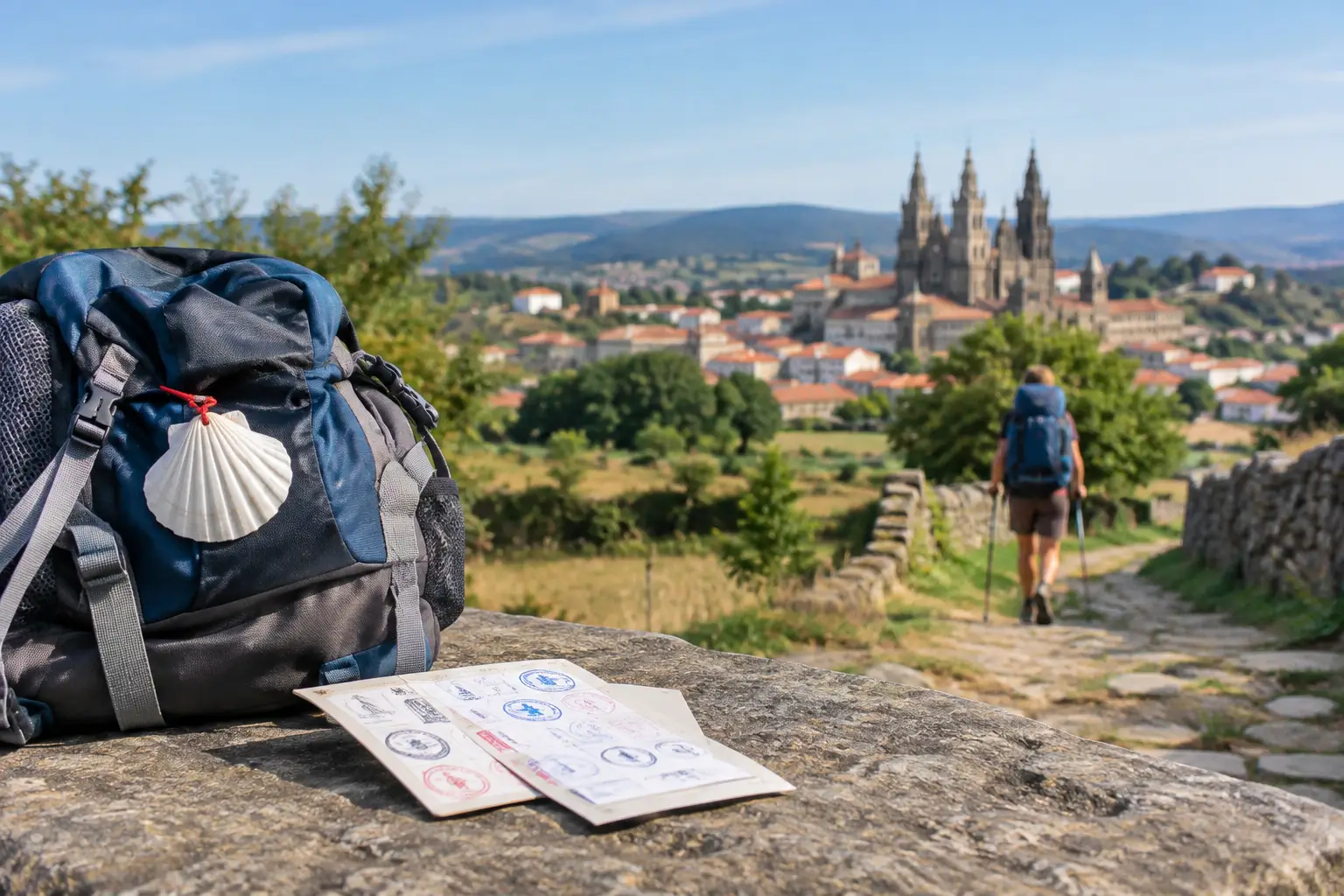
The Compostela certificate requirements are straightforward. To receive the traditional Compostela in Santiago, you need to complete the required distance on a recognized Camino route, carry and stamp an official pilgrim credential, and make the pilgrimage for religious or spiritual reasons. The Compostela is a church document, written in Latin, it is not a general hiking award.
Key requirements for The Compostela
For most walkers, the practical requirements are these:
- Walk at least the final 100 km to Santiago on foot, or travel that distance on horseback.
- Cycle at least the final 200 km to Santiago if completing the Camino by bicycle.
- Follow a recognised Camino de Santiago route leading to Santiago and document your journey with the official pilgrim credential.
- Collect at least two stamps per day during the final 100 km on foot or horseback, or the final 200 km by bicycle.
- State a genuine religious or spiritual motivation for undertaking the pilgrimage if you wish to receive the traditional Compostela.
The final requirement can feel personal, and it is. The Camino has always held many meanings for different people, but the Compostela remains connected to pilgrimage to the tomb of Saint James. If your motivation is entirely cultural, sporting, or tourist-based, ask at the Pilgrims’ Office about the alternative certificate available for nonreligious pilgrims.
Distance requirements by way of travel
The familiar 100 km rule applies to pilgrims travelling on foot or horseback. For cyclists, the minimum is 200 km. These distances must be completed along a recognised Camino route leading to Santiago; simply covering the same distance on unrelated walks or rides does not qualify.
You do not have to complete a longer Camino in one uninterrupted trip. You can walk it over separate trips, provided the sections form a geographically consecutive journey towards Santiago and your credential documents your progress. The final qualifying distance must also meet the applicable requirements.
Popular qualifying starting points
Many pilgrims choose a starting point that naturally meets the minimum distance:
- Sarria to Santiago: approximately 114 km on the Camino Francés.
- Tui to Santiago: approximately 116 km on the Portuguese Central Way.
- Ferrol to Santiago: approximately 113–120 km on the Camino Inglés, depending on the route measurement.
- Ourense to Santiago: approximately 110 km on the Vía de la Plata route.
Distances vary slightly between guidebooks, route maps and stage calculations. Check your planned route and ensure you meet the applicable qualifying distance before setting out.
These are useful options, especially for pilgrims with a week or less. Still, walking farther often gives you more time to settle into the rhythm of the Camino. Beginning in Saint-Jean-Pied-de-Port, Porto, Lisbon, Le Puy, Seville, or another traditional starting point does not make the Compostela more official, but it can make the journey feel very different.
If you combine walking with buses, taxis, or other transport, be honest about what you completed. Short transfers due to injury, safety, or an unavoidable disruption can happen, but they may affect eligibility if they break the required final distance. The Pilgrims’ Office makes the final decision.
Your pilgrim credential is essential
A credencial del peregrino, usually called a pilgrim credential or passport, is the official record of your journey. It is different from a souvenir passport sold as Camino-themed stationery. If you intend to apply for the Compostela, obtain the official credential issued by the Pilgrim’s Office or through an organisation authorised to distribute it. Read our guide to Camino passport and credential requirements, and consult the official Pilgrim’s Office website for the latest instructions.
Each stamp, known in Spanish as a sello, should show where and when you were on the route. Albergues, churches, parish offices, tourist offices, cafés, hotels, and some shops may stamp credentials. An albergue stamp is common, but it is not the only valid kind.
In the earlier part of a long Camino, one stamp per day is generally a sensible record. In the final 100 km for walkers and horseback pilgrims, collect two stamps each day. This rule helps the Pilgrims’ Office verify that the minimum distance was walked over consecutive stages rather than covered by transport.
A simple routine works well: get one stamp when you begin the day and another at your destination. Keep the credential dry, write your name clearly, and do not wait until Santiago to notice that several dates or stamps are missing.
What makes a good stamp record?
Your stamps should tell a coherent story. A credential showing Sarria, Portomarín, Palas de Rei, Arzúa, and Santiago in a logical sequence is easy to understand. One showing large jumps, repeated undated stamps, or no evidence from the final stages may lead to questions.
Do not treat stamp collecting as a competition. A full credential is a lovely memento, but the purpose is to document the pilgrimage, not to gather the greatest number of ink marks. A few well-placed stamps each day are more useful than a page of identical ones.
Religious and spiritual motivation
The Compostela is issued to pilgrims who complete the Camino devotionis affectu, voti vel pietatis causa – broadly, with devotion, because of a vow, or out of spiritual commitment. You do not need to belong to a particular church, and the Pilgrims’ Office does not require a detailed account of your beliefs.
What matters is that you understand the Compostela as a pilgrimage certificate. Many modern pilgrims arrive with mixed motivations: perhaps they came for walking, grief, curiosity, faith, recovery, or reflection. Mixed motives are common. The relevant question is whether a religious or spiritual dimension is genuinely part of your Camino.
If that is not your reason for walking, there is no need to invent one. The Camino is still open to you, and finishing in Santiago is still meaningful. Ask the office for the appropriate nonreligious certificate rather than requesting a document whose purpose does not match your journey.
How to collect the Compostela in Santiago
When you arrive in Santiago de Compostela, keep your credential with you and visit the Pilgrims’ Office. The process and opening arrangements can change with the season, major feast days, and the number of arrivals, so check the current official instructions shortly before reaching the city.
Typically, you will register your arrival, present your credential for review, and answer a brief question about your motivation. If you meet the requirements, your name is written on the Compostela. Check the spelling carefully before you leave the desk, especially if your name has accents, multiple surnames, or an uncommon spelling.
You can also ask about a separate distance certificate, which records the route and distance completed. This is distinct from the Compostela and may be especially appealing if you walked a longer route or want a detailed record for home.
Avoid leaving Santiago immediately after arriving if receiving the certificate matters to you. Give yourself enough time for the office process, a shower, a meal, and the strange adjustment of no longer needing to follow yellow arrows. The city is not merely a finish-line photograph.
Special situations worth checking in advance
Most pilgrims fit neatly within the usual rules, but a few situations deserve advance clarification. Pilgrims using an e-bike, traveling with a disability, walking only selected sections over separate trips, or following a less common historic route should consult the Pilgrims’ Office before setting out. Policies can be interpreted differently depending on the route and how the journey was completed.
Children can receive a Compostela when they have completed the pilgrimage requirements, with practical judgment applied according to their age. Families should carry credentials for each person and collect stamps for everyone walking the route.
If you lose your credential, replace it as soon as possible and explain the situation honestly when you arrive. A replacement may help you continue documenting the journey, but it cannot recreate stamps already lost. Taking a quick photo of each completed page is a sensible backup.
Join The Community
Get the latest Camino guides, packing tips, and historical insights delivered to your inbox. Join a community of fellow pilgrims preparing for their journey.
Carry your credential carefully, collect your stamps without fuss, and you will document the Camino you actually lived. Buen Camino!